One Bag to Rule Them All: How to Find Your Perfect Everyday Carryall
Here's a scenario that probably sounds familiar: you own four bags, and somehow none of them are quite right. The tote is too floppy. The backpack reads too casual for client meetings. The structured satchel doesn't fit your laptop. And the crossbody you love on weekends? Absolutely useless on a Monday when you're hauling a charger, a gym kit, and three folders.
The solution isn't buying a fifth bag. It's being smarter about finding the one bag that actually does the job.
We call it the capsule bag strategy — the same logic behind a capsule wardrobe, applied to what you carry. One intentional, well-chosen everyday carryall that moves through your whole life without friction. Here's how to find yours.
Start With Your Actual Day, Not Your Ideal Day
Before you fall down a rabbit hole of bag reviews, map out what your day actually looks like. Not the aspirational version where you glide into the office at 9 a.m. with a single notebook. The real version — the one where you're also carrying lunch, a laptop, AirPods, a reusable water bottle, and maybe a change of shoes.
Ask yourself:
- Do you commute by subway, bus, or car?
- Do you go straight from work to other plans most days?
- Are you in client-facing meetings where appearance matters?
- Do you hit the gym before or after work?
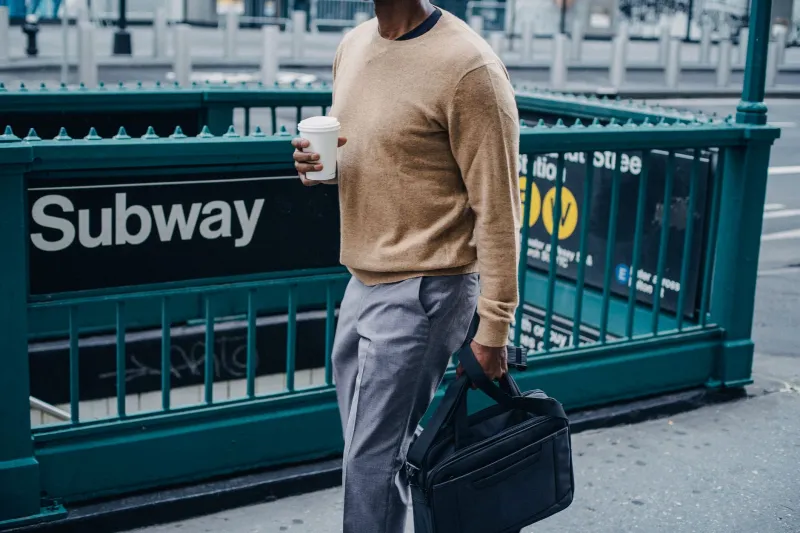
Your answers determine your non-negotiables. A subway commuter in New York needs something that stays secure in a crowd. Someone who goes from desk to dinner needs a bag that doesn't scream "I work in a cubicle." Getting honest about your routine is step one.
The Size Sweet Spot: Not Too Big, Not Too Small
Size is where most people get it wrong, and they usually err on one of two extremes. Either they grab a massive tote that becomes a black hole of stuff, or they go sleek and minimal and end up carrying things in their hands anyway.
For most urban professionals, the sweet spot is somewhere between 20 and 30 liters of capacity. That's enough to fit a 13- to 15-inch laptop, a compact pouch or organizer, a water bottle, and the everyday essentials — without turning into a bag you dread picking up.
If you're frequently on the move between offices or hopping on the train, lean toward structured bags that hold their shape. Slouchy bags are charming until you're digging through a collapsed pile of stuff looking for your MetroCard.
Material Matters More Than You Think
The material your bag is made from will determine how it ages, how it looks in different contexts, and how much maintenance it demands. Here's a quick breakdown:
Full-grain or pebbled leather is the gold standard for professional settings. It softens and develops character over time, looks appropriate everywhere from a boardroom to a brunch spot, and holds up to years of daily use. The trade-off is cost and weight.
Nylon and ballistic nylon are workhorses. Lightweight, water-resistant, and nearly indestructible. Brands like Tumi and Knomo have made technical nylon feel genuinely elevated. Great for commuters who deal with unpredictable weather.
Canvas sits in a middle ground — casual enough for weekends, polished enough for most offices depending on the cut. It's also lighter than leather, which matters when you're already carrying a lot.
Vegan leather has improved dramatically. If you're avoiding animal products or just want a lower price point, modern PU options can look convincing — just be aware they don't age the same way genuine leather does.
For the single everyday bag, leather or high-quality nylon tends to be the most versatile investment.
The Organization Question
A bag with no internal structure is just a bucket. And a bucket is a nightmare.
Look for a bag with at least one dedicated laptop sleeve (padded, ideally), a quick-access exterior pocket for your phone and transit card, and some internal organization — a few slip pockets, a key clip, maybe a zippered compartment.
You don't need 47 pockets. You need the right pockets. The goal is that everything has a home, so you're never fishing around at the bottom.
One underrated feature: a luggage pass-through sleeve on the back. If you travel for work even occasionally, the ability to slide your bag over a rolling suitcase handle is genuinely life-changing.
Style That Travels Across Contexts
Your everyday bag needs to work in multiple registers — professional enough for a Monday morning meeting, relaxed enough for a Saturday coffee run. That rules out anything too extreme in either direction.
Neutral colorways (black, tan, navy, slate gray) are your friends here. They pair with everything and don't date the way trend-driven colors do. Classic silhouettes — a structured tote, a clean backpack, a streamlined messenger — hold up over time.
When in doubt, the question to ask is: Would this bag look out of place in a meeting room? And then: Would it look try-hard at a dive bar? If the answer to both is no, you've found a contender.
A Few Real-World Picks by Lifestyle
The Corporate Commuter: A structured leather tote with a laptop sleeve and top handles. Something like the style of a Mark & Graham or Cuyana tote hits the right note — polished, professional, and doesn't look like a laptop bag even though it is one.
The Hybrid Worker: A convertible backpack-to-tote that can shift depending on the day. Good for someone who's in the office two or three days a week but also runs errands and hits the gym in between.
The Frequent Flyer: A technical nylon carry-on-friendly backpack with a TSA pass-through. Built to travel, but refined enough to walk into a client office without apology.
The Creative Professional: A structured canvas or leather messenger bag with room for a sketchbook, laptop, and camera. Function-forward but with enough personality to feel intentional.
The Investment Mindset
Here's the thing about the capsule bag strategy: it's actually a money-saving move. Instead of cycling through mediocre options that each solve half the problem, you put that budget toward one bag that solves the whole thing.
Spend what you need to spend to get it right. A $300 bag you use every day for five years costs less per wear than a $60 bag you replace every year and resent the whole time.
Treat it like a uniform piece. Take care of it — condition leather, clean nylon, store it properly. The right bag doesn't just carry your stuff. It quietly pulls your whole look together, every single day.
That's not a small thing. That's the whole point.