Weather-Proof Your Wardrobe: The City Pro's Complete Guide to Layering Like a Pro
Anyone who's ever walked out of a Manhattan high-rise in a wool overcoat on a 58-degree October afternoon knows the struggle. By noon, you're sweating through your third-floor meeting. By 6 PM, that same breeze has turned sharp enough to regret leaving your jacket at your desk. Welcome to city dressing — where the forecast is a suggestion and your outfit needs to do actual work.
Layering isn't just a cold-weather trick. Done right, it's a full-season strategy that lets you adapt to subway heat, office AC, and rooftop happy hours without skipping a beat. Here's how to build outfits that move with you, not against you.
Start With the Right Foundation
Everything begins with what's closest to your skin. A lot of people overlook the base layer because it's hidden, but it quietly determines whether the rest of your look holds up or falls apart by midday.
For city commuters, breathability is non-negotiable. Look for lightweight merino wool or moisture-wicking cotton blends — fabrics that regulate temperature without clinging or bulking up. A slim-fit crew neck or fitted long-sleeve tee in a neutral tone (white, grey, navy) gives you a clean starting point that works under everything.
Avoid thick cotton basics as your first layer. They trap heat and take forever to dry if you get caught in unexpected rain or work up a sweat on the platform. Merino, in particular, is worth every penny — it handles temperature swings surprisingly well and doesn't hold odor through a long day.
The Middle Layer Is Where Style Lives
If the base layer is functional, the mid-layer is where your personal aesthetic shows up. This is your fleece, your lightweight knit, your structured shirt jacket — the piece that carries the most visual weight in your outfit.
For professionals who need to look polished, a tailored half-zip or a fine-gauge crewneck sweater threads the needle between office-appropriate and street-ready. Pair either with trousers and you've got a meeting-ready silhouette. Tuck in a fitted base layer underneath and you can pull the sweater off mid-afternoon without looking underdressed.
One underrated mid-layer move: the overshirt or shirt jacket. Worn open over a tee or buttoned up as a standalone top, it adapts fast. Brands like Faherty and Corridor make versions that photograph well on a Zoom call and still feel relaxed enough for a post-work beer. That versatility is exactly what city dressing demands.
Silhouette tip: When layering, keep your proportions in check. A slim base layer under a slightly relaxed mid-layer under a structured outer layer creates visual depth without bulk. Avoid stacking two oversized pieces — it reads sloppy, not intentional.
The Outer Layer Does the Heavy Lifting
Your outermost layer is your weather shield and your style statement. In transitional seasons — think March in Chicago or November in D.C. — you want something that's genuinely warm when the wind picks up but not so heavy it becomes a burden by noon.
A few outer layer archetypes that consistently earn their place in urban wardrobes:
- The quilted vest: Keeps your core warm without restricting arm movement. Ideal for mild days when a full jacket feels excessive.
- The harrington or bomber jacket: Lightweight enough to stuff in a bag, structured enough to look intentional over a button-down.
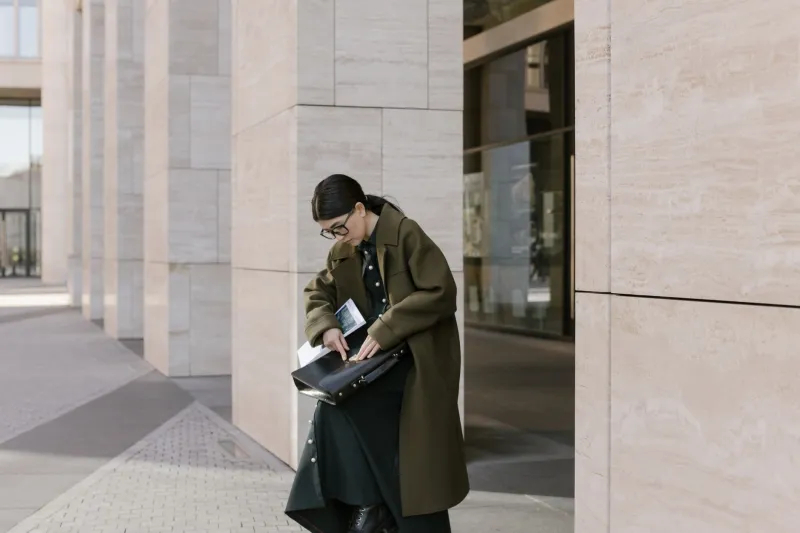
- The unlined trench: A perennial city staple. Protects against wind and light rain, works over both casual and professional looks, and never goes out of style.
- The softshell jacket: For the commuter who walks or bikes — wind-resistant, packable, and increasingly available in elevated colorways that don't scream "outdoorsy."
The key is choosing an outer layer you can actually carry when you don't need it. A coat that won't compress into a tote bag is a liability on a 70-degree afternoon.
Fabric Combinations That Actually Work
Not all fabric pairings play nicely together. Some combinations look visually chaotic; others create texture clashes that undermine an otherwise solid outfit. A few combinations that consistently work:
- Merino wool base + chino trousers + waxed cotton jacket: Earthy, grounded, and functional. Works for creative offices and weekend errands alike.
- Cotton tee + structured blazer + wool overcoat: Classic professional layering. The blazer acts as a mid-layer you can keep on indoors; the coat comes off at the door.
- Thermal henley + denim + nylon bomber: More casual but still intentional. Great for remote workers who need to look put-together for afternoon meetings without feeling overdressed.
Stick to a cohesive color palette across your layers — three tones maximum. Neutrals anchor everything, and one muted accent color keeps it from looking flat.
Mobility Matters More Than You Think
City life is physical. You're walking, climbing stairs, squeezing onto the L train, hauling a laptop bag. Your layers need to move with you, not fight you.
When shopping for mid and outer layers, do a simple reach test: put the jacket on and raise both arms above your head. If the hem rides up or the shoulders pull, it's too restrictive for daily urban use. Articulated sleeves, gusseted underarms, and stretch panels aren't just athletic features — they're urban survival tools.
Also consider weight distribution. A heavy outer layer over a bulky mid-layer creates shoulder fatigue on long commutes. Lighter, more technical fabrics let you get the same warmth with less physical burden.
The One-and-Done Outfit Formula
Here's a real-world formula that works across most urban scenarios — commute, office, and evening — without requiring you to swap anything out:
Base: Slim merino crewneck in charcoal or navy
Mid: Tailored overshirt or structured blazer
Outer: Lightweight trench or harrington jacket
Bottom: Dark slim chinos or tailored joggers
Shoes: Clean leather sneakers or Chelsea boots
The blazer or overshirt stays on in the office. The trench comes off and gets folded over your arm or hung at your desk. After work, ditch the outer layer entirely and let the blazer carry the evening look. No changes. No bag full of backup clothes.
That's the whole point of strategic layering — not more outfit options, but smarter ones. When your wardrobe works as a system, city life gets a lot easier to dress for.